Why can’t you understand native speakers when you can read the language?
Because reading and listening are different skills, and real speech removes most of the help that text gives you. On a page, every word is spelled out with a space on either side. In speech, there are no spaces, many sounds are shortened or dropped, and nothing waits for you to catch up.
Most learners know the feeling. You read a sentence and know every word in it, then hear the same sentence from a native speaker and catch almost none of it. That is not a sign that your vocabulary is weak. It usually means your ear has not yet learned what those words sound like in connected, everyday speech.
Why do words you know go past unrecognised?
Because in natural speech words run together and lose sounds, so the version you hear is often not the version you learned. Learners struggle most at this first stage, turning sound into words, before they ever get to what the sentence means.
Goh (2000) asked learners of English to describe their listening problems as they happened, through diaries, group interviews and recall straight after listening. She identified ten problems across the stages of perceiving, parsing and using what was heard. Five sat in the earliest stage, perception, and were linked to failures of word recognition and attention. The less able listeners had more of these low-level problems than the more able ones.
Reduced words are one reason. In everyday speech, native speakers shorten common words, sometimes dropping whole syllables. In experiments on Dutch, Ernestus, Baayen and Schreuder (2002) found that even native listeners recognised heavily reduced word forms well only when they heard them in their full sentence context. With less context, recognition fell the more a word was reduced. If native listeners lean on context to decode reduced words, a learner, who has less context to work with, will miss far more of them.
Is native speech really that fast?
Partly, but less than it feels. Some languages do pack in more syllables per second than English. Pellegrino, Coupé and Marsico (2011) compared adult speakers of seven languages reading comparable short texts at a normal pace. English averaged about 6.2 syllables per second, Spanish about 7.8, French about 7.2, Italian about 7.0 and German about 6.0. Spanish, French and Italian carried less information in each syllable, so they were not delivering more meaning per second than English. There was simply more sound to split into words.
Speed still matters once it passes a certain point. Introducing his 1992 study, Griffiths described the overall relationship as clear: beyond a certain rate, comprehension declines as speech gets quicker. So speed is a real factor, but much of what learners hear as speed is really the joins and missing sounds described above.
How many of the words do you need to know?
Most of them. Van Zeeland and Schmitt (2013) tested listening by swapping real words in spoken stories for made-up ones. Most listeners still understood the stories adequately when they knew 90% of the words, but scores among non-native listeners varied widely at that level. At 95%, the non-native listeners did relatively well and varied much less.
Native speech is full of words that courses rarely teach: everyday expressions, slang, filler words and subject vocabulary. Each unknown word is also a gap in the sound stream you then have to work around. Our guide to the intermediate plateau explains why those less common words take so long to collect.
Is it harder in some languages than others?
Yes, and the hard part is different in each. These are the main traps for English speakers, with more detail on each language’s page:
- Spanish joins words across their edges and merges neighbouring vowels into one syllable, on top of a high syllable rate. See Spanish.
- French links final consonants to the next word, drops unstressed vowels and stresses only the end of each phrase, so a sentence arrives as a few long sound groups. See French.
- German is not quicker than English, but it often holds the key verb back until the end of the sentence, so you have to keep a lot in mind before the meaning arrives. See German.
- Dutch drops sounds the spelling keeps, such as the final n of lopen and eten, and sends parts of the verb to the end of the sentence. See Dutch.
- Italian carries meaning in the length of its consonants, including across word boundaries, and varies a great deal by region. See Italian.
- Portuguese is two listening tasks: European Portuguese swallows unstressed vowels, while Brazilian Portuguese changes its consonants. See Portuguese.
How do you train your ear for native speech?
By listening to a lot of real speech at a level you can mostly follow, with the right support, and changing how you listen as well as how much. These habits work with any app, course or video:
- Listen to real speech, not only learner audio. Clear course recordings are a good start, but they don’t train you for joined words and dropped sounds. Add real native speech as soon as you can follow some of it.
- Read along in the language you are learning. Seeing the words while you hear them shows you where one word ends and the next begins. In a study by Mitterer and McQueen (2009), Dutch listeners watched a film or sitcom in an unfamiliar Scottish or Australian accent of English, with English subtitles, Dutch subtitles or none. Afterwards, those who had seen English subtitles repeated new speech in that accent better than those who had seen none, while Dutch subtitles made them worse. The subtitles in the spoken language helped them learn the sounds; the translations got in the way.
- Check meaning with a translation, but don’t live in it. A translation is the quickest way to find out what a line means. Read it after you have tried the line in the original, not instead of it. Our page on dual-language subtitles covers the research on showing both languages, and our guide to target-language or English subtitles covers when each one helps.
- Replay short clips. Listen once for the gist, again while reading along, and once more without the text. Each pass leaves less that you can’t hear. Our guide to learning from native video without pausing every word sets out a routine.
- Listen with a plan. Predict what you are about to hear, notice what you missed, and work out why. In a semester-long study of 106 university students of French, Vandergrift and Tafaghodtari (2010) taught one group to plan, monitor, evaluate and problem-solve as they listened, while another group heard the same texts the same number of times without that guidance. The guided group did significantly better on the final comprehension test, and its less skilled listeners gained more than its more skilled ones.
- Slow it down, then speed it back up. Turning the playback speed down brings a hard clip into range. Once it makes sense, play it again at normal speed so your ear learns the real version.
- Stay with subjects and speakers you know. Familiar topics give you context, and context is exactly what listeners use to decode reduced words. Our page on native videos at your level covers why related videos get easier.
- Learn the reduced forms as words in their own right. When you notice that a word always sounds shorter than it is spelled, learn the short version too. That is the form you will meet most.
How Bingua fits in
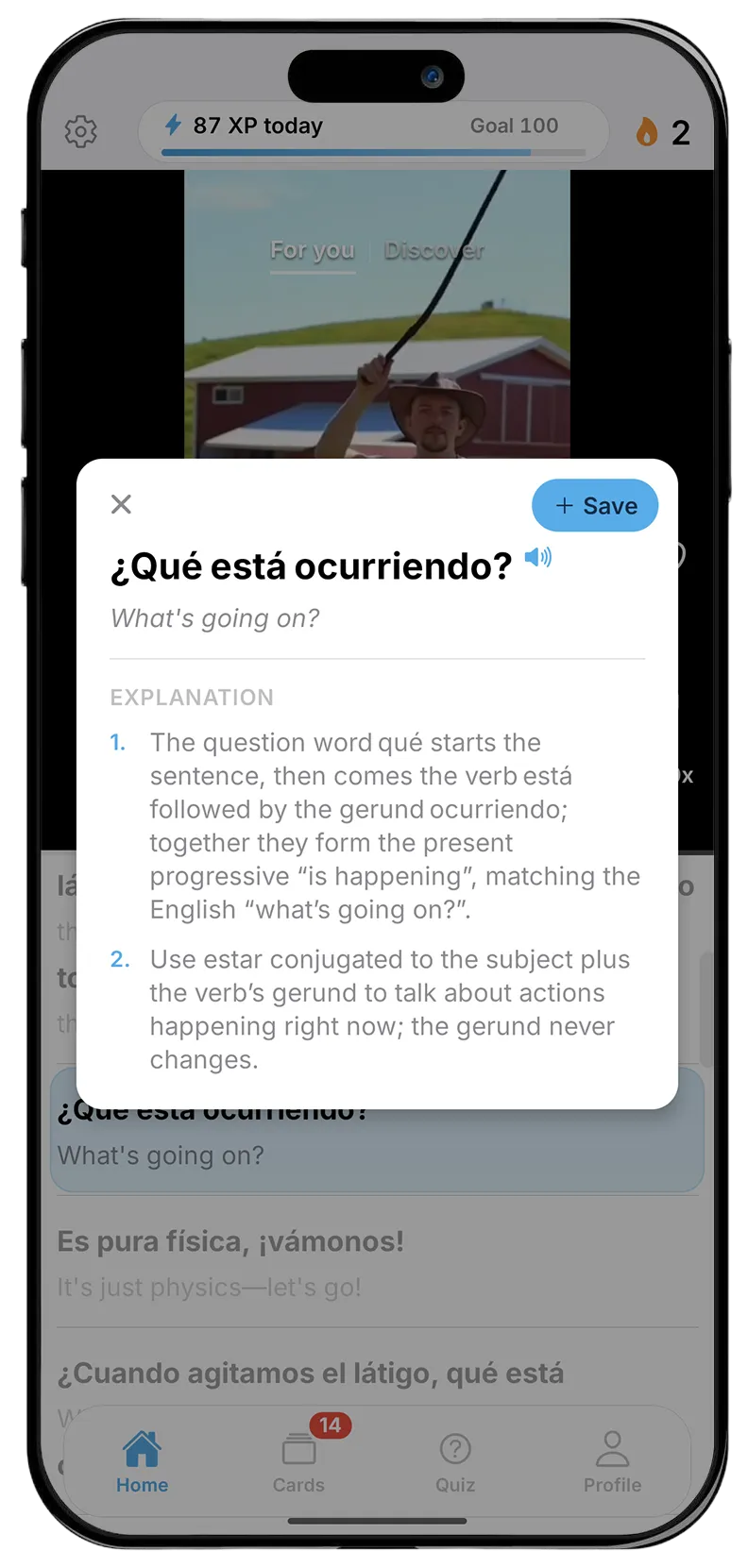
Bingua was designed for exactly this gap. It is an iPhone app with an endless feed of real videos made by native speakers, in Spanish, French, German, Dutch, Italian or Portuguese. Under each video, a transcript scrolls in time with the speech: the line in the language you are learning, with the English line beneath it, so you can see where the words are and check the meaning without leaving the video. Tap any word for its translation and a note on what it is doing in that sentence, or swipe a line for a breakdown of how the sentence fits together. The feed gives beginners slower-spoken videos and advanced learners quicker ones, and you can turn the speech speed down in settings.