What are dual-language subtitles?
Dual-language subtitles, also called bilingual or dual subtitles, show two lines at once: what is being said, in the language being spoken, and a translation into a language you already know.
They sit between the two usual options. Captions show only the spoken language, which is ideal once you can mostly follow along and hard work before that. Translated subtitles show only your own language, which makes a video easy to follow but lets the language you are trying to learn wash past you. Two lines let you follow the meaning and still see the original words. Our guide to target-language or English subtitles covers what research finds for each single-language option.
Do bilingual subtitles help you learn?
They appear to help with one thing in particular: learning what new words mean. In a 2022 study published in Language Learning, Andi Wang and Ana Pellicer-Sánchez had 112 intermediate to advanced Chinese learners of English watch a documentary with bilingual subtitles, captions, translated subtitles or no subtitles, while an eye tracker recorded where they looked. The bilingual-subtitle group did better than the captions group at recognising what the target words meant, and better than the translated-subtitles group at recalling their meanings.
The same study is clear about the trade-off. Captions alone beat bilingual subtitles for recognising the written form of the new words. Viewers with both lines spent more time reading the translation of a new word than the word itself, and it was attention to the word in the language being learned, not to its translation, that predicted how much they learned.
That last finding is the practical one. Two lines help, as long as your eyes start on the line you are learning.
Learning words from video at all is well supported. Peters and Webb (2018) found that Dutch-speaking learners of English picked up word meanings from watching a single full-length TV programme, and that how often a word appeared, whether it was a cognate (similar to a word in their own language), and the size of their existing vocabulary all affected how much they learned.
How do you use dual-language subtitles well?
These habits work with any player or app that shows two lines:
- Read the line you are learning first, then glance at the translation to check. The translation is a safety net, not the main text.
- Listen while you read. Matching what you hear to what you see is the point of watching rather than reading.
- Notice the words that keep coming back. Words you meet several times are the ones most likely to stick, so they are the best ones to look up and save.
- Lean on the top line as a video gets easier. Captions do more for recognising how words are written, so the translation should matter less over time.
- Choose videos you would watch anyway. You will watch more of them.
How does Bingua do it?
In Bingua, every video comes with a dual-language transcript that scrolls in time with the speech: the line in the language you are learning on top, and the English line beneath it. You are watching a video, not working through a lesson, and the translation is always one glance away.
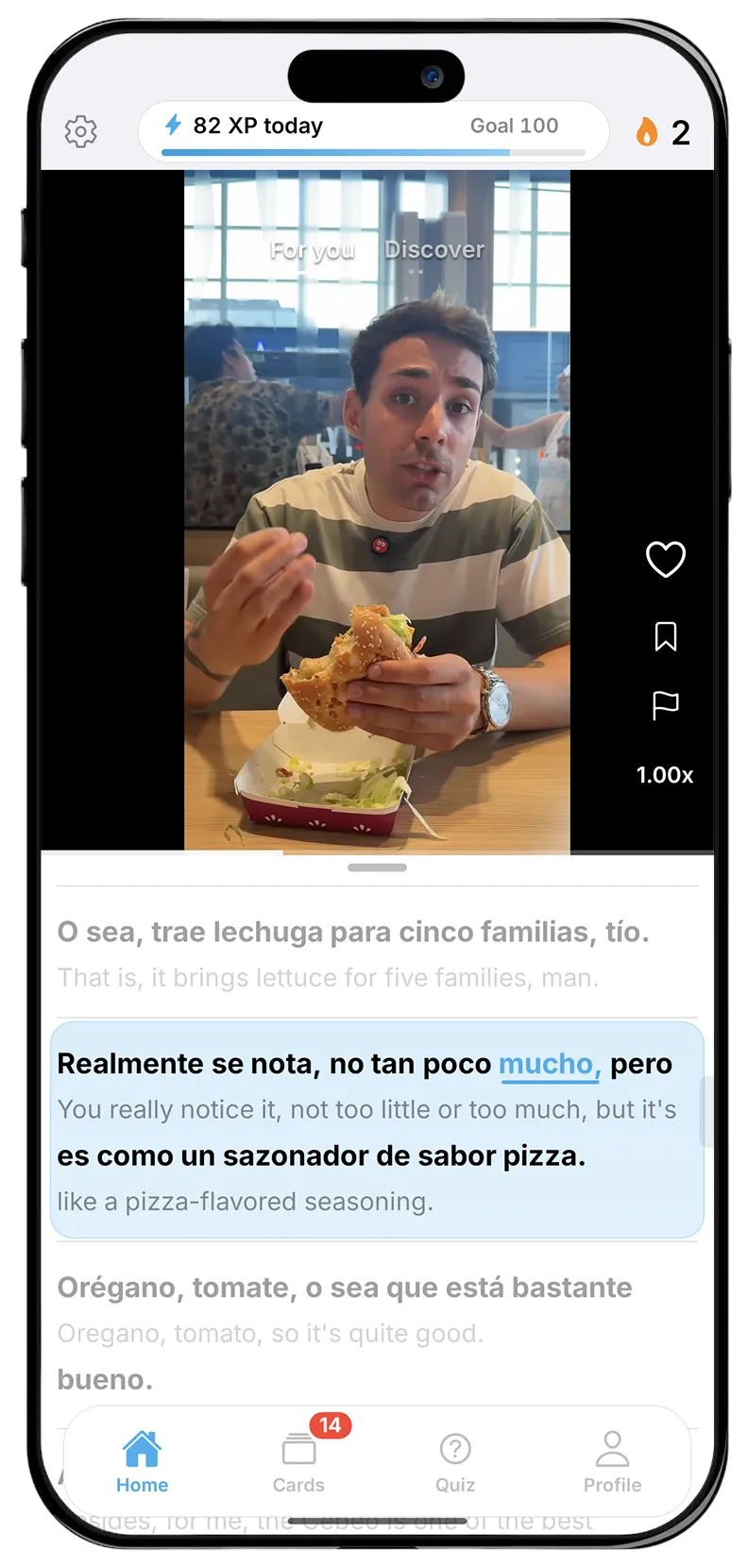
When a word on the top line stops you, tap it for its meaning in that sentence (how tapping a word works). When a whole line is confusing, swipe it sideways for a short breakdown of how the sentence fits together. Anything worth keeping can be saved with one tap and comes back later as a flashcard.
Bingua has dual-language transcripts in Spanish, French, German, Dutch, Italian and Portuguese, always with English as the translation.