What do you do when an unknown word goes past?
When a word you don’t know goes past in a video, you have three options: ignore it, guess, or stop and look it up. Each one costs something.
Ignoring it is fine for a word you will never see again, but not for one you keep meeting. Guessing works when the context is clear and fails quietly when it isn’t, so you can end up confidently wrong. Stopping to type the word into a dictionary works, but it pulls you out of the video, and that constant switching is often what makes the habit fade.
Tap-to-translate removes most of that cost: the meaning is one tap away, and you never leave what you were watching.
What does research say about getting the meaning in the moment?
Having the meaning available makes repeated encounters count. In a study by Hulstijn, Hollander and Greidanus (1996), Dutch advanced students of French read a short story either with translations of unknown words in the margin, with a bilingual dictionary, or with neither. Meeting a word more than once did more for learning it when readers were given its meaning, through the margin notes or the dictionary, than when they had nothing to go on. Without that help, the authors note, readers often ignore unknown words or infer their meanings incorrectly.
That study was about reading, but the same logic applies to watching. Peters and Webb (2018) found that learners pick up word meanings from viewing TV, and that words appearing more often were learned better. Real video gives you the repeated encounters; a quick, reliable way to check the meaning makes sure each one builds on the last instead of on a guess.
Why does the meaning in this sentence matter?
Many words mean different things in different places, and a dictionary gives you all of them and leaves you to choose. In casual Spanish, tío is often not “uncle” at all. In a line like “O sea, trae lechuga para cinco familias, tío”, it means something closer to “man” or “mate”: “That is, it brings lettuce for five families, man.”
Knowing what a word does in the sentence in front of you is what lets you understand the line and remember the word the way it is actually used.
How does tapping a word work in Bingua?
Tap any word in the transcript and a card opens right where you were already looking. It shows the translation, what kind of word it is, and a plain-English note on what the word is doing in that particular sentence.
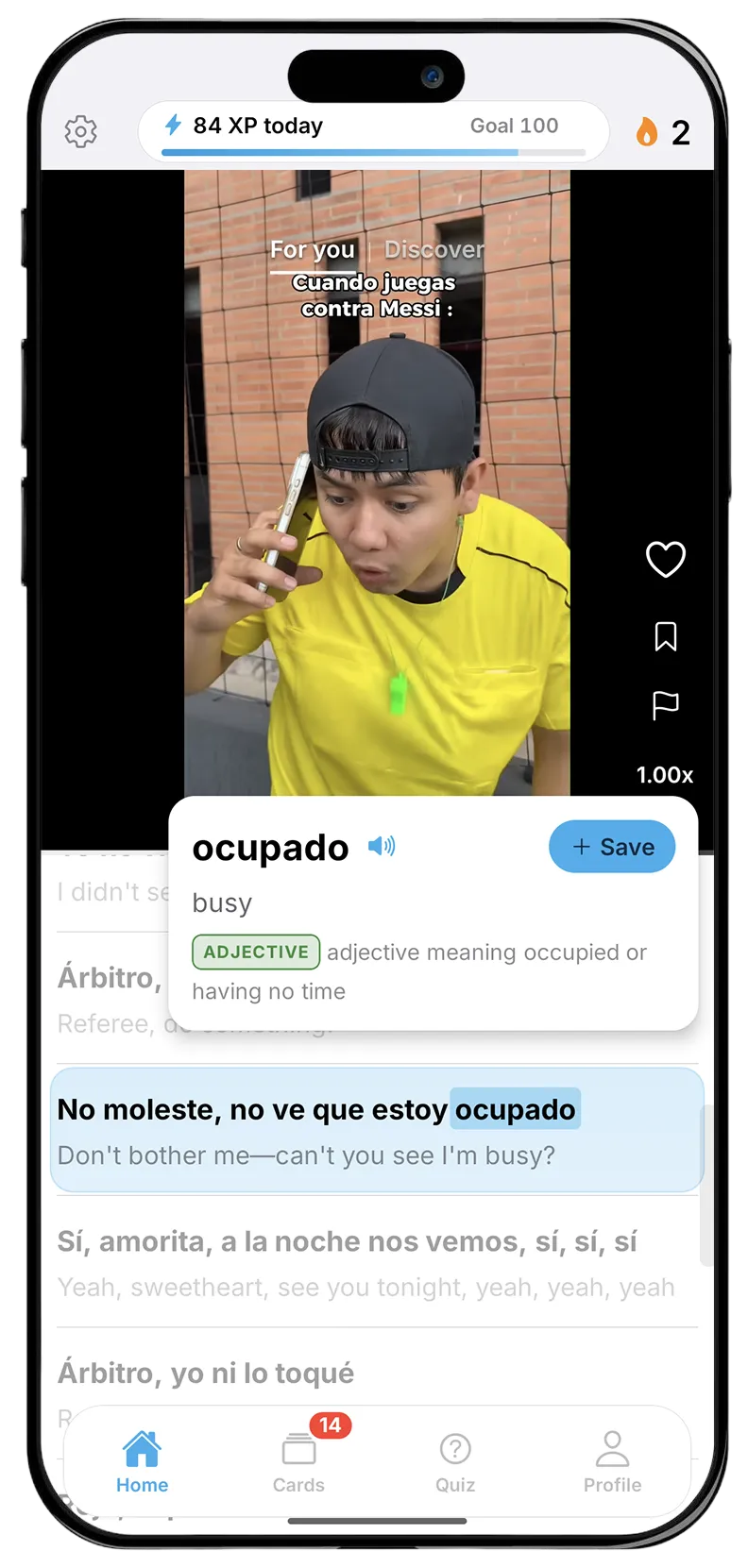
If the word is worth keeping, tap + Save. That is the whole action: no deck to pick, no form to fill in. Saved words come back later as flashcards.
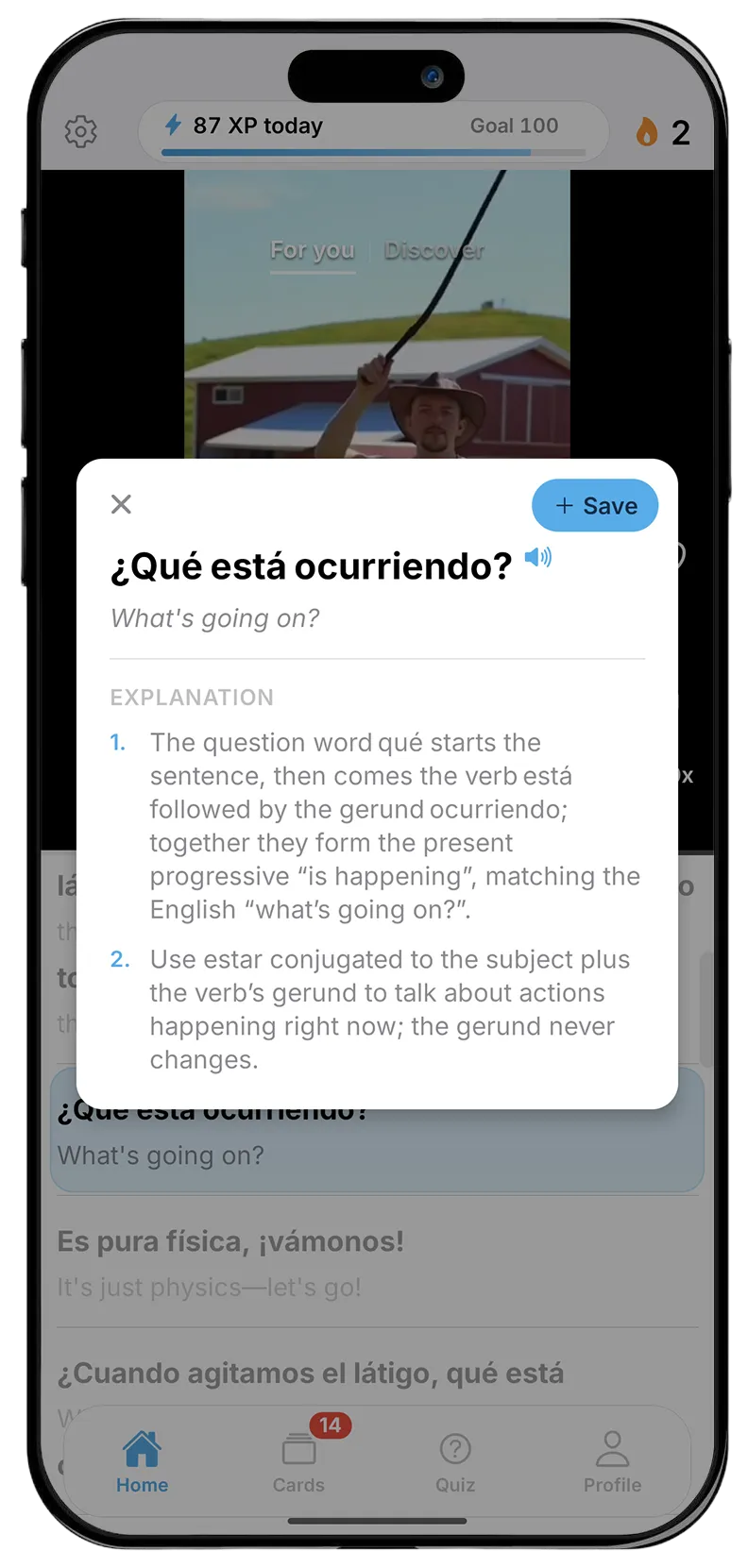
When it is the whole sentence that is confusing rather than one word, swipe that line sideways. You get a short breakdown of how the sentence fits together, the kind of thing a tutor would lean over and tell you, and you can save the sentence too.
How do you look up words well?
A few habits that help with any tool:
- Look up what stops you understanding, not every word you don’t know. If you followed the line anyway, keep watching.
- Look up words that keep coming back. A word you have met three times is worth more than a word you will probably never hear again.
- Read the meaning in context, not just the first translation. Check that it makes sense in the line you heard.
- Listen to the line again after looking a word up, so you hear it with its meaning attached.