Why is native video so hard to follow?
Two things make it hard, and they add up: how quickly people talk, and how many of their words you know.
Course audio is usually recorded slowly and clearly, with vocabulary chosen for the level. Real people talking about something they care about do neither. They speak at their natural pace, run words together, and use whatever words they need. That is exactly what makes native video worth learning from, and exactly what makes it overwhelming before you are ready for it.
How does speech rate affect what you understand?
Up to a point, not much; past it, a lot. Introducing his 1992 study, Griffiths described the overall relationship as clear: beyond a certain rate, comprehension declines as speech gets quicker. An earlier study he reports found that speech above about 200 words per minute impaired comprehension for lower-intermediate learners of English.
So slowing speech down helps most when it brings a video back under that threshold for you, and the right speed depends on your level.
How many words do you need to know?
Most of them. Webb and Rodgers (2009) analysed 88 English TV programmes and found that knowing the 3,000 most frequent word families, plus proper nouns and marginal words, covered 95.45% of the words in them. Reaching 98.27% coverage took the 7,000 most frequent word families.
How much coverage you need was tested directly by Durbahn and colleagues (2024), who replaced 5%, 10% or 20% of the words in short documentaries with made-up words. Comprehension fell as coverage fell, with the best adequate comprehension reached at 95% of words known and minimal adequate comprehension at 80%.
In practice this means a video can be fine for one learner and opaque for another, purely because of which words they already know. Videos that suit your level, with translations and look-ups for the words you are missing, keep you in the range where you follow the story and pick up new words along the way.
Does watching videos on the same topics help?
It gives you more chances to meet the same words. Rodgers and Webb (2011) compared the scripts of related TV programmes with unrelated ones and found that related programmes contain fewer different word families for the same amount of speech, and that less common words come back more often across them. The study looked at episodes of the same programmes, but the principle carries over: sticking to related subjects means more of the same words come back, and words you meet repeatedly are the ones that have a chance to stick.
How does Bingua match videos to your level?
When you set Bingua up, you choose your level and tell it which subjects interest you. The feed then picks real videos made by native speakers to match: slower-spoken videos for beginners, and quicker speech as your level goes up. You can change your level later.
Speech speed is a separate setting, so you can also turn the speed down for any video without changing your level.
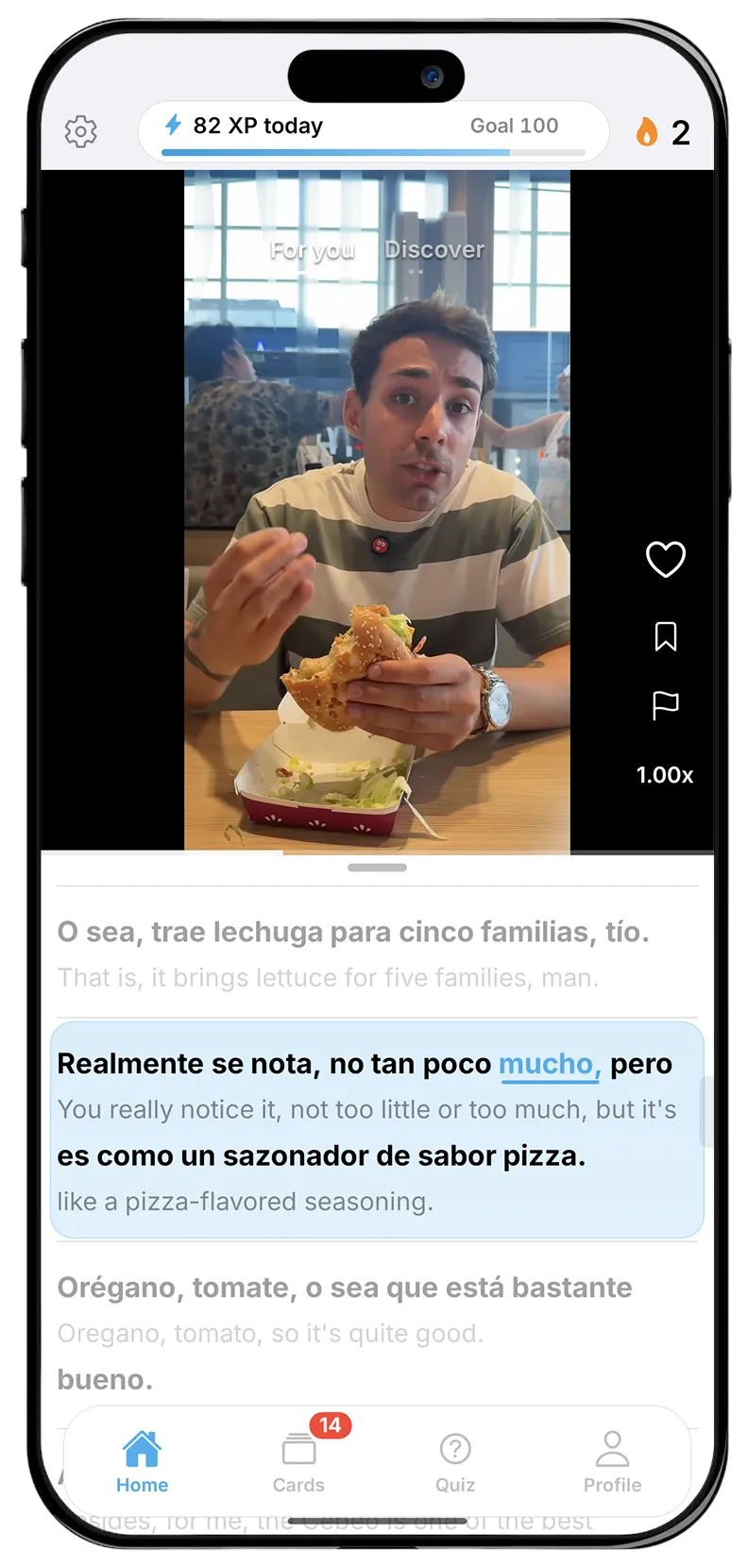
Every video comes with a dual-language transcript and every word can be tapped for its meaning, so the words you don’t know yet don’t stop the video making sense.
How do you find the right level?
Whatever you watch with, these rules of thumb help:
- Start easier than you think. If you are following the story and noticing a few new words, the level is right. If you are decoding every line, it is too hard for now.
- Pick subjects you know. Familiar topics make it easier to work out what new words mean.
- Rewatch. A second viewing of a short video is often where it clicks.
- Move up gradually. When videos at your level start to feel comfortable, try the next one up, or put the speed back to normal.