Why is spoken Italian hard to follow?
Because Italian carries meaning in the length of its consonants, lengthens consonants across word boundaries in a way spelling never shows, and sounds noticeably different from one region to the next.
There is also more sound per second than in English. Pellegrino, Coupé and Marsico (2011) compared adult speakers of seven languages reading comparable short texts at a normal pace. Italian averaged about 7.0 syllables per second, against about 6.2 for English. Each Italian syllable carried less information, so Italian was not delivering more meaning per second, but there were more syllables to split into words.
Why do double consonants matter so much in Italian?
Because a single and a double consonant can be the only difference between two words. In Italian, a double letter between vowels stands for a consonant pronounced with more force and length, and fifteen consonants can be either short or long (Treccani). That gives pairs like cane (dog) and canne (canes), caro (dear) and carro (cart), rosa (rose) and rossa (red), note (notes) and notte (night).
If your ear is not used to listening for consonant length, the difference is easy to miss at first. It is worth training early, because once you hear it, a lot of words stop being ambiguous.
Region matters here too. Northern dialects tend to reduce double consonants to single ones, and the same article notes that in the north, especially the Veneto, speakers can find it hard even to perceive the extra length of some consonants. Dialects shape the regional Italian spoken on top of them, so doubles can sound weaker in video from the north than from the centre or south.
Why do Italians double consonants between words?
It is called raddoppiamento sintattico, and it lengthens the first consonant of a word because of the word before it. It happens after a word stressed on its last syllable, as in città pulita or tre cani, and after a set of short words such as a, e, ho, è, se, come and dove (Treccani). So a casa is said as a ccasa, and ho fame as ho ffame.
The spelling only shows it where two words have been fused into one: soprattutto, eccome, sennò. Everywhere else it is invisible on the page. It is part of standard Italian, which is based on Tuscan, and of many central and southern varieties, but it is absent from northern varieties. The same phrase, then, can sound different depending on where the speaker is from, and a consonant that sounds doubled at the start of a word may not be doubled in the word itself.
Which Italian will you hear?
Regional Italian, nearly always. Italian varies by area in its sounds, intonation, words and grammar, and “regional Italian” refers above all to how people speak (Treccani). The textbook standard is traditionally based on the Italian of Florence. In everyday national usage, for example, the distinction between open and closed e and o that the standard makes may not exist at all, or may fall on different words.
Behind the regional accents are the dialects, which in most of Italy are not accents of Italian but separate descendants of Latin. They are still widely used. In Istat’s survey for 2015, 45.9% of people aged six and over spoke mainly Italian with their family, 32.2% used both Italian and dialect, and 14% spoke mainly dialect (Istat). Intonation and speaking style in particular follow the local dialect, so someone speaking perfectly good Italian usually still sounds like they are from somewhere: Rome, Naples or Milan.
Tu, Lei or voi: which “you” will you hear?
Tu is the informal “you” and Lei the polite one, and standard Italian has all but abandoned the third option, voi (Treccani). Lei is grammatically third person, so the verb is the same one you would use for “she”: mi direbbe per favore che ora è? is a polite way of asking you, not her, what time it is. Italian often leaves the pronoun out entirely, so the verb form may be the only clue.
The capital letter that tells Lei (you) from lei (she) exists only in writing. In speech they sound the same, and context has to do the work.
Outside the standard, though, the older polite voi has not disappeared. It is especially rooted in the south, in family settings and with older relatives, and it is more common among older people. You are likely to hear it in video from southern Italy, addressed to a single person.
What are the Italian false friends to watch for?
The familiar-looking ones. A great deal of Italian vocabulary shares Latin roots with English, which helps with reading, but some of the words that look most like English mean something else. These four are checked against the Treccani dictionary:
- Camera is a room in a house, not a camera (camera).
- Parenti are relatives of any kind, by blood or by marriage, not just parents (parente).
- Libreria is a bookshop, or a collection of books, not a library (libreria).
- Morbido means soft to the touch, not morbid (morbido).
The grammar habit that most affects listening is the dropped pronoun. Because Italian can leave out io, tu or lei, the verb ending often carries who is doing what on its own.
How do you learn Italian from native video?
Watch Italian you can mostly follow, keep the text on screen, and give your ear specific jobs: consonant length, regional sound, verb endings. Any video source will do:
- Start with one region, then branch out. Get used to one set of sounds, say from Rome or Milan, before mixing in others. Once a regional rhythm stops surprising you, new ones get easier.
- Train on double consonants. When you meet a pair like caro and carro, listen for the extra length, and check the written word until you can hear it without looking.
- Read along to see where doubling comes from. When you hear a ccasa, a transcript spells it a casa, so you learn that the doubling belongs to the phrase, not the word. Our page on dual-language subtitles covers the research on reading along.
- Turn the speed down. At around seven syllables a second, slowing playback a little gives your ear time to hear consonant length. Our page on videos at your level explains how speech rate affects comprehension.
- Listen for the verb ending. With no pronoun, the ending tells you who is acting, and only context tells Lei (you) from lei (she).
- Check false friends in the moment. If camera or parenti goes past, look it up rather than trusting the English look-alike. Our page on tap-to-translate covers why checking meanings as you go helps.
The idea underneath these tips is comprehensible input: lots of real Italian, pitched just above what you can comfortably follow. If you have been learning for a while and native speakers still lose you, our guide to the intermediate plateau looks at why.
Scrolling Italian with Bingua, and keeping the words you find
Bingua is an iPhone app for learning Italian from real videos made by native speakers, with dual-language transcripts you can tap for instant translations and flashcards built from the words you save.
The routine is simple enough to fit anywhere: scroll through native Italian video picked around your interests and your level, tap what you don’t know, and carry on. The transcript scrolls in time with the speech, the Italian line above and the English beneath it, so you can see the single or double letter while you listen for it (dual-language subtitles). Tap a camera or a morbido and a card shows its translation, the kind of word it is and a note on what it is doing in that sentence (tap-to-translate).
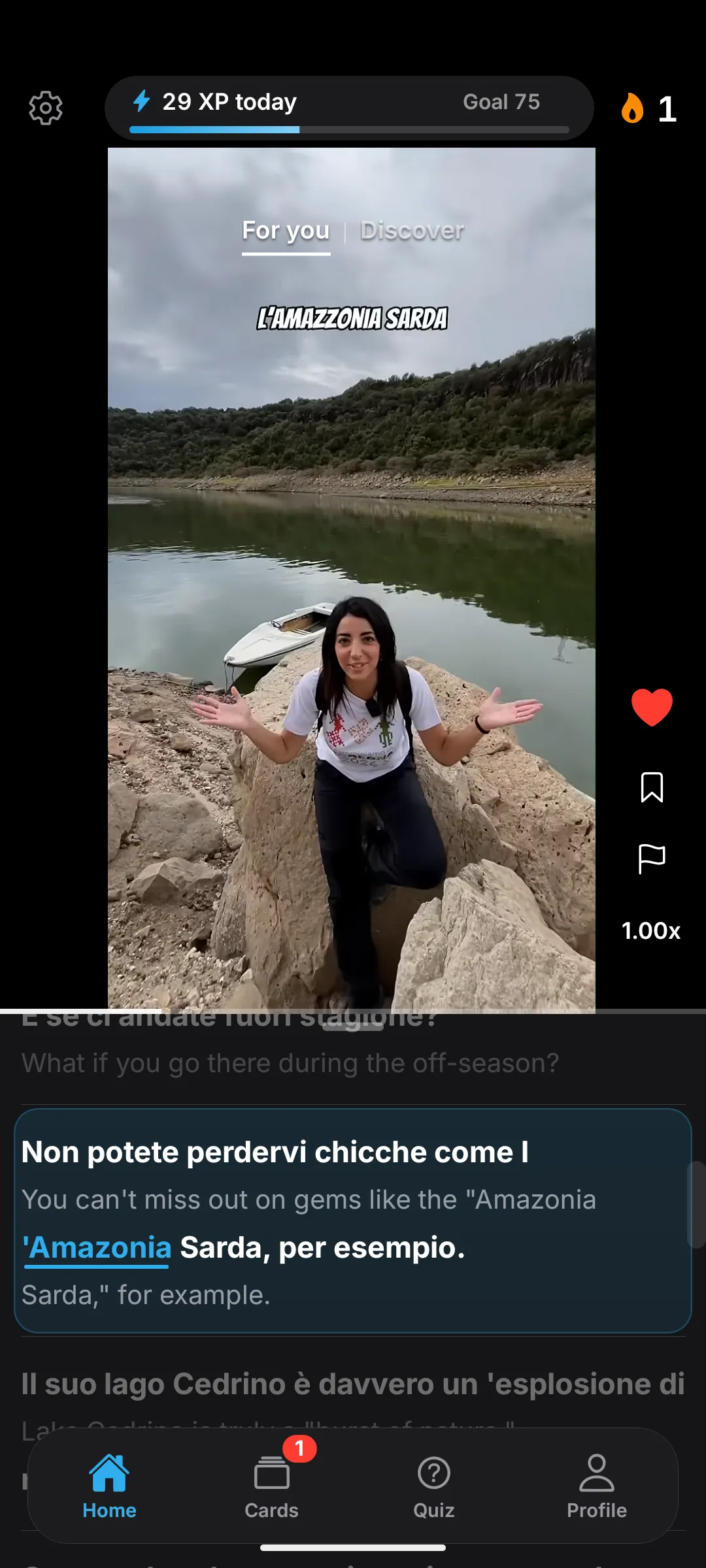
What turns that scrolling into learning that sticks is the review. Tap + on a word or a sentence and it becomes a flashcard, with no deck to choose, and it comes back when you are about to forget it (flashcards from videos). When you want more practice, a quiz builds questions entirely from your own saved cards: listening, typing, matching, and saying the words out loud into the microphone. For a language where caro and carro differ only in length, hearing and saying your own words again is useful practice. Every card in the deck came from a video you chose to watch, so nothing you review feels assigned.
Beginners get slower-spoken videos and advanced learners quicker ones, and you can turn the speech speed down in settings (videos at your level). When a dropped pronoun leaves you unsure who did what, swipe the line sideways for a breakdown of how it fits together.
Bingua works without an account. It is a subscription app; see pricing.