Why is spoken Portuguese hard to follow?
Because Portuguese is really two listening tasks: European Portuguese swallows its unstressed vowels, and Brazilian Portuguese changes its consonants, so a learner trained on one can be thrown by the other.
Both varieties start from the same seven vowels, but they treat them very differently on the surface, above all in unstressed syllables (Ulrich, Revista da ABRALIN, reviewing work by Marina Vigário). That is a big part of why the same sentence can sound so different from one side of the Atlantic to the other.
Why does European Portuguese sound so different from Brazilian?
Because European Portuguese reduces or deletes its unstressed vowels far more often than Brazilian Portuguese does. The result is that the stressed syllable stands out sharply and the syllables around it shrink, sometimes to nothing: ministro can be said as mnistro (Ulrich). European Portuguese is described as having a stress-based rhythm, while the rhythm of Brazilian Portuguese is organised more around its syllables.
Brazilian Portuguese goes the other way. It keeps its unstressed vowels and even adds one where a word would otherwise start with two consonants together, so pneu (tyre) is said as pineu.
For a listener, this cuts both ways. Brazilian speech keeps the vowels the spelling shows you. European Portuguese gives you clear stressed syllables but fewer of those vowels, so syllables you expect to hear from the spelling can be missing. Speakers from Portugal can even tell the two varieties apart from rhythm alone, in recordings where the words themselves have been made unrecognisable.
Why do Brazilians pronounce t and d like “tch” and “dj”?
Because in most varieties of Brazilian Portuguese, t and d before an i sound become affricates: tijolo (brick) sounds like tchijolo and dinheiro (money) like djinheiro (Gutierres and Battisti). It also happens before an unstressed final e, which Brazilians pronounce as i, so leite (milk) comes out as leitchi and onde (where) as ondji.
How regular it is depends on the city. The change is virtually categorical in about half of Brazil’s state capitals, and it applies at different rates elsewhere, more often to t than to d. Once you expect it, words that sounded new turn out to be ones you already know.
Tu, você or a gente: which pronouns will you hear?
Brazil and Portugal use the words for “you” differently. In Portugal, tu and você are split by the relationship between the speakers, which makes the system more complex than it looks. In Brazil they are not split that way: você is the form across a large central area of the country, while in other regions tu and você exist side by side, with one or the other dominating (Bacelar do Nascimento, Duarte and Mendes).
Then there is a gente. Literally “the people”, in speech it often means “we”, and it takes a singular verb: a gente vai rather than nós vamos. Ciberdúvidas treats both as correct, though for years it was taught in Portugal that a gente for “we” was a mistake (Ciberdúvidas). If you hear a singular verb where you expected nós, a gente is probably the subject.
Which Portuguese words don’t mean what they seem?
Mostly the ones that look like English. Shared Latin roots make a lot of Portuguese readable for English speakers, but some look-alikes mean something else, and one even changes meaning between Portugal and Brazil. These are checked against the Priberam dictionary:
- Puxar means to pull towards you (puxar), the opposite of what it looks like to an English speaker expecting “push”.
- Esquisito can mean strange or odd, or fussy: ele é muito esquisito com a comida means he is very fussy about food (esquisito).
- Livraria is a bookshop, not a library (livraria).
- Constipação in Portugal is a head cold, which Brazilians call resfriado. It can also mean constipation (constipação), which is how many English speakers will read it.
Spelling shifts a little too. Priberam gives atualmente (at present) as the spelling under the 1990 spelling agreement and actualmente as the spelling from before it (atualmente), so in older or European texts you will meet both.
How do you practise Portuguese with real video?
Pick one variety, watch plenty you can mostly follow, keep the text on screen, and listen for the vowels and consonants described above. These steps work with any source of video:
- Stick with one variety at first. Brazilian and European Portuguese differ most in sound, so get comfortable with one before mixing them. The second then sounds like a variation on something you know, not a new language.
- Read along to recover missing vowels. In European Portuguese, a transcript shows you the vowels that speech has squeezed out, so mnistro can be matched to ministro. Our page on dual-language subtitles covers the research on reading along.
- Learn the Brazilian consonant pattern. Expect tch and dj before an i sound, including the end of words like leite and onde, and the words will snap back into ones you know.
- Turn the speed down. Slower playback gives you time to hear reduced syllables in European speech. Our page on videos at your level explains how speech rate affects comprehension.
- Listen for a gente. A singular verb with a “we” meaning usually means a gente, not a mistake.
- Check look-alikes in the moment. If puxar or constipação goes past, look it up rather than trusting the English. Our page on tap-to-translate covers why checking meanings as you go helps.
All of this rests on one idea, set out in our guide to comprehensible input: understand a lot of real Portuguese and the language builds up. If you are well past the basics but still can’t keep up with native speakers, read our guide to the intermediate plateau.
Learning Portuguese by scrolling with Bingua
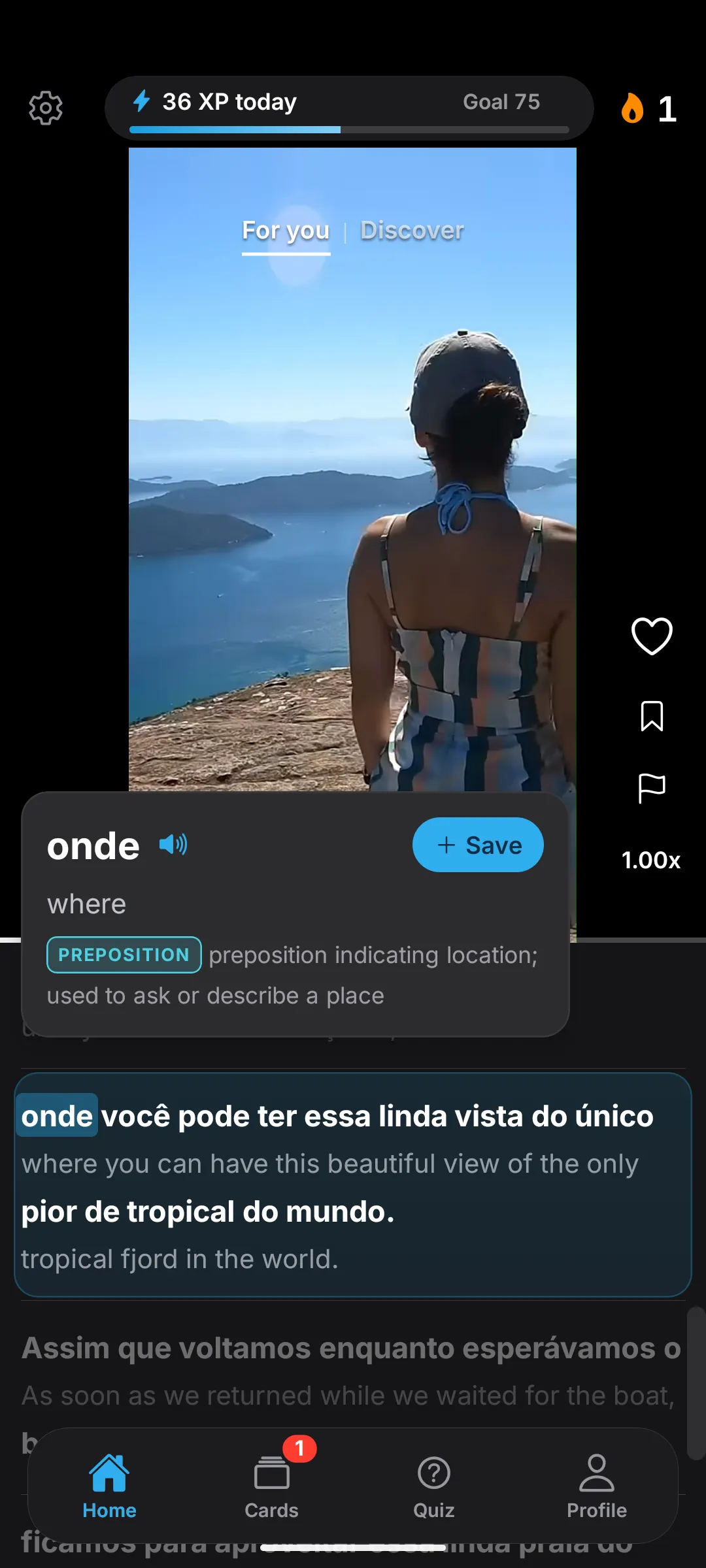
Bingua is an iPhone app for learning Portuguese from real videos made by native speakers, with dual-language transcripts you can tap for instant translations and flashcards built from the words you save.
Bingua is built around a feed, not lessons, and that is what makes it easy. Open the app and a video made by a native speaker is already playing, chosen around the subjects you picked when you set up; scroll and the next one starts. You set a daily goal yourself, the bar at the top fills as you watch and save words, and a streak keeps count of the days you hit it. It is the scrolling you might do anyway, pointed at Portuguese.
The feed matches your level, too. Beginners get slower-spoken videos and more advanced learners quicker ones, and the speech speed can be turned down in settings, which helps when European Portuguese squeezes its syllables together (videos at your level).
Every video has a transcript that scrolls in time with the speech, the Portuguese line above and the English beneath it (dual-language subtitles). Tap a puxar or an esquisito for its translation, the kind of word it is and a note on what it is doing in that sentence (tap-to-translate), or swipe a line like a gente vai sideways for a breakdown of how it fits together. What you save comes back as flashcards when you are about to forget it.
Bingua works without an account. It is a subscription app; see pricing.