Why is native Spanish so hard to follow?
Because Spanish packs a lot of syllables into each second and runs its words together, so the gaps between words that you learned on paper are not there to hear.
Start with the syllables. Pellegrino, Coupé and Marsico (2011) compared recordings of adult speakers of seven languages reading comparable short texts at a normal pace. Spanish averaged about 7.8 syllables per second, against about 6.2 for English, and Spanish and Japanese had the highest syllable rates in the study. Each Spanish syllable carried less information, so Spanish was not delivering more meaning per second than English. There was simply more sound to process.
Then the joins. Spanish links the end of one word to the start of the next. A final consonant attaches to the vowel that follows it, and vowels from neighbouring words merge into a single syllable, which Spanish calls sinalefa (Real Academia Española). A University of Washington pronunciation textbook, I’m All Ears, gives the example Los hermanos del hombre con el bastón tienen hambre, which comes out as lo-ser-má-nos-de-lóm-bre-co-nel-bas-tón-tié-ne-nam-bre. The silent h disappears, the s of los moves onto hermanos, and where one word ends is no longer audible.
Native speakers do this far more than learners expect. In a study of English-speaking learners of Spanish, Willis, Holt and Carver (2025) asked people to retell a story and counted how often they linked neighbouring vowels across words. Intermediate learners linked them in 49% of the places they could, advanced learners in 68%, and the native comparison group, from Mexico, in 93%.
The rhythm is different too. English is usually described as stress-timed: stressed syllables stretch, and the vowels around them shrink to a schwa, the uh sound in the first syllable of English banana. Spanish is described as syllable-timed. Each syllable gets about the same time and unstressed vowels keep their full sound, so Spanish banana has three clear a sounds (I’m All Ears). If your ear is used to picking out English stress, an even stream of full syllables can sound like one long word.
Which Spanish sounds does English not have?
Only a few, and most are easy to hear once you know to listen for them. The I’m All Ears textbook covers each one:
- Two kinds of r. The single tap in caro (expensive) exists in American English, as the t in “what a” or the dd in “buddy”. The trill in carro (car), with several taps, has no English equivalent, and the two words differ only by it (3.3).
- P, t and k without the puff of air that English gives them, and a t made with the tongue against the back of the teeth rather than the ridge behind them (3.1).
- B and v are the same sound, so tubo (tube) and tuvo (he had) sound identical and context tells you which you heard (3.8).
- Five steady vowels. Spanish vowels keep the same quality whether stressed or not, and they are relatively stable across dialects of all regions, so the vowels you learn hold wherever the speaker is from (2).
Which Spanish will you hear, Spain or Latin America?
Both, if you watch widely, and the differences you will notice first are a few consonants and the words for you. These are the ones that change what you hear most:
- Z and soft c. In central, northern and eastern Spain, z and c before e or i are pronounced with the tongue between the teeth, much like English th in think. In south-western Spain, the Canary Islands and all of Latin America they are pronounced as s, so zapato sounds like sapato (z). This is called seseo, and the Spanish language academies accept it fully as standard (seseo).
- Ll and y. In large parts of Spain and the Americas, ll and y are pronounced the same, so caballo sounds like cabayo. Among young people this is practically universal, and it is accepted as standard (yeísmo).
- The disappearing s. In southern Spain, the Canary Islands and much of Latin America, an s at the end of a syllable or word is often breathed like an h: pescado sounds like pehcado. In many places it disappears altogether, so los hombres y las mujeres can come out as lo ombre i la muhere (s). Plurals and verb endings that you rely on in writing can be nearly silent.
Tú, usted, vos or vosotros: which “you” will you hear?
Usted is the formal “you” everywhere; the informal forms are where regions split. Usted takes a third-person verb, tiene usted razón (you are right), and implies some distance and politeness in both Spain and the Americas (usted).
In the plural, most of Spain uses vosotros among friends and family, with its own verb forms such as habláis. Latin America, western Andalusia and the Canary Islands do not use vosotros at all, and ustedes covers formal and informal alike (vosotros).
Then there is vos. In Argentina, Uruguay and Paraguay, vos replaces tú, is accepted across all social classes, and comes with its own verb forms: vos llegás, cantás, comés, vivís. Vos also lives alongside tú as the familiar form in Chile, most of Central America, the Pacific coast of Colombia and the Mexican states of Tabasco and Chiapas (voseo). If you hear a stress on the end of a verb, as in tenés or sabés, you are probably listening to vos.
What do English speakers get for free, and what trips them up?
Plenty of vocabulary looks familiar, but a few false friends and grammar habits catch most English speakers out.
Many words are near twins: transacción, teléfono, excelente, atención. They are easier to read than to hear, though, because the stress and vowels change: teléfono is stressed on its second syllable and every vowel is full.
The false friends are fewer, but they matter. These four are worth knowing early, each checked against the Real Academia Española’s dictionary:
- Librería is first of all a bookshop (librería).
- Éxito means success, not an exit (éxito).
- Actual means current or present-day, so actualmente is “at present” (actual).
- Constipado means a cold (constipado).
Three grammar habits change how you listen:
- Gender. Every noun is masculine or feminine, and articles and adjectives agree with it (género). La, el and adjective endings carry information you can use to keep track of what is being talked about.
- No subject needed. Spanish does not require a subject: vino y nos dijo means “he came and told us” with no word for he (pronombres personales tónicos). The verb ending is often the only clue to who did what, and it is exactly the part a disappearing s can swallow.
- Small pronouns before the verb. Object pronouns sit in front of a conjugated verb, te lo dije (I told you so), and attach to the end of a command, dímelo (tell me it) (pronombres personales átonos). Spoken, te lo dije runs together as a single unit.
How do you practise Spanish with native video?
Choose videos you can mostly follow, keep the Spanish text on screen, and train your ear on the specific things above. This works whatever you watch with:
- Start with one region, then branch out. Get used to one set of sounds, say Mexico or Spain, before mixing in others. Once seseo, a breathy s and vos stop surprising you, new accents get easier.
- Read along to find the word boundaries. When los hermanos sounds like lo sermanos, the transcript shows you where the words really start. Our page on dual-language subtitles covers the research on reading along.
- Turn the speed down. With that many syllables per second, slowing playback a little gives your ear time to split the stream into words. Our page on videos at your level explains how speech rate affects comprehension.
- Listen for the verb ending. With no subject pronoun, the ending tells you who is acting. Notice -mos, -áis and -n, and the voseo endings if you watch Argentine or Uruguayan speakers.
- Check false friends in the moment. If actual or éxito goes past, look it up rather than guessing. Our page on tap-to-translate covers why checking meanings as you go helps.
- Retell what you watched, out loud. In the Willis, Holt and Carver study, learners linked their vowels more when retelling a story than when reading aloud, so retelling is good practice for producing the joined-up speech you are learning to hear.
The principle behind all of this is in our guide to comprehensible input: spend a lot of time with real Spanish that is just hard enough to follow. If you are past the basics and feel stuck, the guide to the intermediate plateau explains why and what to do about it.
Learning Spanish by scrolling, at a speed you can follow
Bingua is an iPhone app for learning Spanish from real videos made by native speakers, with dual-language transcripts you can tap for instant translations and flashcards built from the words you save.
Learning with it feels like scrolling because it is scrolling. You open the app, a Spanish video is already playing, and when you scroll the next one starts, picked around the subjects you chose. There is no lesson to begin and nothing assigned, so it is easy to keep going: the studying happens while you watch.
What makes that work for Spanish is that the feed matches your level. With nearly eight syllables a second in normal speech, there is a lot of sound to take in, so beginners get slower-spoken videos and more advanced learners get quicker ones, and you can turn the speech speed down in settings whenever a speaker runs away from you (videos at your level). Every video has a transcript that scrolls in time with the speech, with the Spanish line above and the English line beneath it, so lo-ser-má-nos is los hermanos again on the screen (dual-language subtitles).
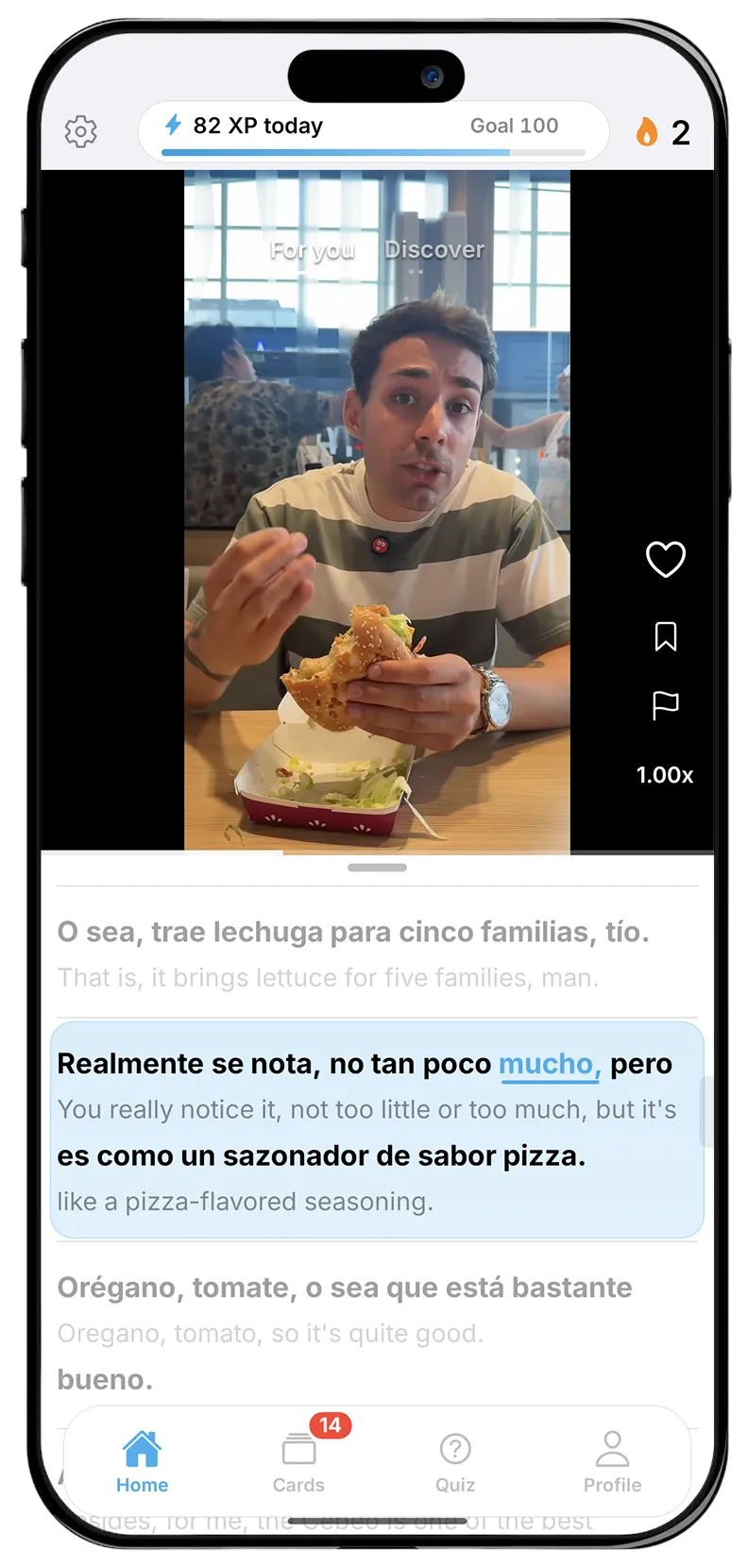
Tap any word, an actual or a constipado, and a card shows its translation, the kind of word it is and a note on what it is doing in that sentence (tap-to-translate). Swipe a line like te lo dije sideways for a breakdown of how it fits together. The words and sentences you save come back as flashcards when you are about to forget them.
Bingua works without an account. It is a subscription app; see pricing.