Why is spoken French so hard to follow?
Because French joins its words into phrases, drops sounds the spelling still shows, and stresses only the end of each phrase, so a sentence reaches your ear as a few long groups rather than a row of separate words.
The joins come first. In liaison, a final consonant that is silent when the word stands alone is pronounced at the start of the next word if that word begins with a vowel (Office québécois de la langue française). The s of les is silent in les livres but sounds like a z in les amis, and vous êtes comes out as vou-zêtes (Français interactif). In enchaînement, a consonant that is always pronounced runs straight into the next word, as in partir avec elle. In elision, a vowel disappears altogether before another vowel and the spelling marks it with an apostrophe: je aime becomes j’aime, le ami becomes l’ami. Put the three together and the boundaries between words, which are obvious on the page, are simply not there to hear.
Then the missing e. French drops the unstressed e (e muet) at the end of a phrase, and inside a word or phrase when only one consonant comes before it, so vêtement is said as vêt’ment. How many get dropped also depends on how fast someone is talking (Français interactif).
Then the stress. English gives every word its own stressed syllable, even inside a sentence. French puts the stress on the last syllable of a whole phrase, treating the phrase much like a single word (Français interactif). If you are used to listening for English stress to find where words start, French gives you one landmark per phrase instead of one per word.
And there are simply more syllables. Pellegrino, Coupé and Marsico (2011) compared adult speakers of seven languages reading comparable short texts at a normal pace. French averaged about 7.2 syllables per second, against about 6.2 for English. Each French syllable carried less information, so French was not delivering more meaning per second, but there was more sound to split into words.
Why do French speakers leave out “ne”?
Because in everyday French the ne of a negative is usually dropped, and the textbook je ne sais pas is heard as je sais pas. A study at the Tokyo University of Foreign Studies analysed more than 20,000 negatives produced by native speakers. In two large corpora of interviews with speakers from France, ne was dropped 89.2% of the time in one and 86.3% in the other, even though the interviews were a fairly formal setting. Among friends and family it was almost always dropped, while people reading a speech aloud almost always kept it.
So the word that tells you a sentence is negative is usually the second one: pas, jamais, rien, plus, personne. If you only listen for ne, you will miss most of the negatives you hear.
Which French sounds does English not have?
The nasal vowels are the big one. French has four. Three of them are worth learning to hear first: the vowel in an, en and science, the one in cinq and italien, and the one in bon and communication. Air passes through the nose as well as the mouth, and the n or m written after the vowel is not pronounced at all, as it would be in English (Français interactif). Pairs like bonne and bon, fine and fin, or peau and pont differ only in whether the vowel is nasal.
Familiar words change shape too. Communication is spelled as in English, but in French the stress falls on its last syllable and that syllable ends in a nasal vowel, so it can pass you by in speech even though you would recognise it instantly in writing.
Which French will you hear: France, Quebec, Belgium or Switzerland?
All of them, if you watch widely, and Quebec is the one learners notice first. In the French spoken in Quebec, t and d before the vowels i and u are generally pronounced ts and dz: tulipe sounds like tsulipe, du like dzu, and lundi like lundzi (Office québécois de la langue française). Once you know to expect it, the words are the same ones you already know.
Belgium and French-speaking Switzerland differ most in vocabulary. The best known example is numbers: where France says soixante-dix for seventy, Belgium and French-speaking Switzerland say septante (Académie française). It is worth knowing before you watch Belgian or Swiss speakers talk about prices, ages or dates.
Tu or vous: which “you” will you hear?
Vous is the polite “you” for one person, and tu marks closeness. Vous is what people generally use with someone they are meeting for the first time, with superiors and with older people. Tu is more common between people who are close and in less formal settings, and teenagers, young adults and family members use it with each other without thinking (Office québécois de la langue française).
Quebec is the exception to watch for. Saying tu at a first meeting is much more frequent there than in other French-speaking places, where it can come across as overly familiar. If you watch both Quebec and European speakers, you will hear tu in situations where a speaker in Paris would probably say vous.
Which French words fool English speakers?
The false friends: words that look like English but mean something else. Many French words look familiar on the page, and most of them are what they seem, but these four are checked against the Larousse dictionary and worth knowing early:
- Actuellement means at present, in the current circumstances, not “actually” (actuellement).
- Librairie is a shop that sells books, not a library (librairie).
- Blesser means to wound or injure someone, and figuratively to hurt their feelings (blesser).
- Assister à means to be present at something, so assister à un match is to attend a match; assister quelqu’un is the one that means to help (assister).
Three listening habits help more than any word list:
- Use the article to find the noun. Liaison often happens between an article or a number and its noun, so the z or n you hear at the start of a word often belongs to the word before it: trois enfants, un escargot (Français interactif).
- Wait for the end of the phrase. The stressed syllable at the end of each group is the most prominent sound you will get, so the last word of a phrase is often the easiest one to catch.
- Listen for the second half of the negative, not for ne.
How do you train your ear for French with native video?
Watch a lot of French you can mostly follow, keep the text on screen while your ear catches up, and listen on purpose for the joins and dropped sounds above. None of this depends on a particular app:
- Start with one variety, then branch out. Get used to French from France or from Quebec before mixing them. Once tsu for tu or a tu from a stranger stops surprising you, other accents get easier.
- Read along to find the word boundaries. When liaison turns les amis into what sounds like one word, a transcript shows you where each word really starts. Our page on dual-language subtitles covers the research on reading along.
- Turn the speed down. At around seven syllables a second, a little less speed gives you time to split each phrase into words. Our page on videos at your level explains how speech rate affects comprehension.
- Listen to the end of each phrase. Notice where the stress falls and which word carries it. That is the word to catch first.
- Check false friends in the moment. If actuellement or librairie goes past, look it up rather than trusting the English look-alike. Our page on tap-to-translate covers why checking meanings as you go helps.
- Rewatch short videos. On a second viewing you already know what is being said, and your attention is free for the joins and dropped sounds.
Why this works is explained in our guide to comprehensible input: a lot of real French, just hard enough to follow, does more than any amount of textbook dialogue. If you already know plenty of French but still lose native speakers, the guide to the intermediate plateau is about exactly that stage.
Scrolling through French with Bingua: the transcript shows what your ear misses
Bingua is an iPhone app for learning French from real videos made by native speakers, with dual-language transcripts you can tap for instant translations and flashcards built from the words you save.
Learning this way is easy because there is no lesson to start. Open the app and a French video is already playing, picked around the subjects you chose; scroll, and the next one begins. Nothing is assigned. You watch things you would watch anyway, and the studying happens along the way.
What makes French watchable this way is the transcript. It scrolls in time with the speech, the French line on top and the English line beneath it (dual-language subtitles). That is exactly what liaison and elision take away from your ear: on the screen, les amis is two words again and j’ai has its apostrophe. Your eyes find the word boundaries while your ears learn to.
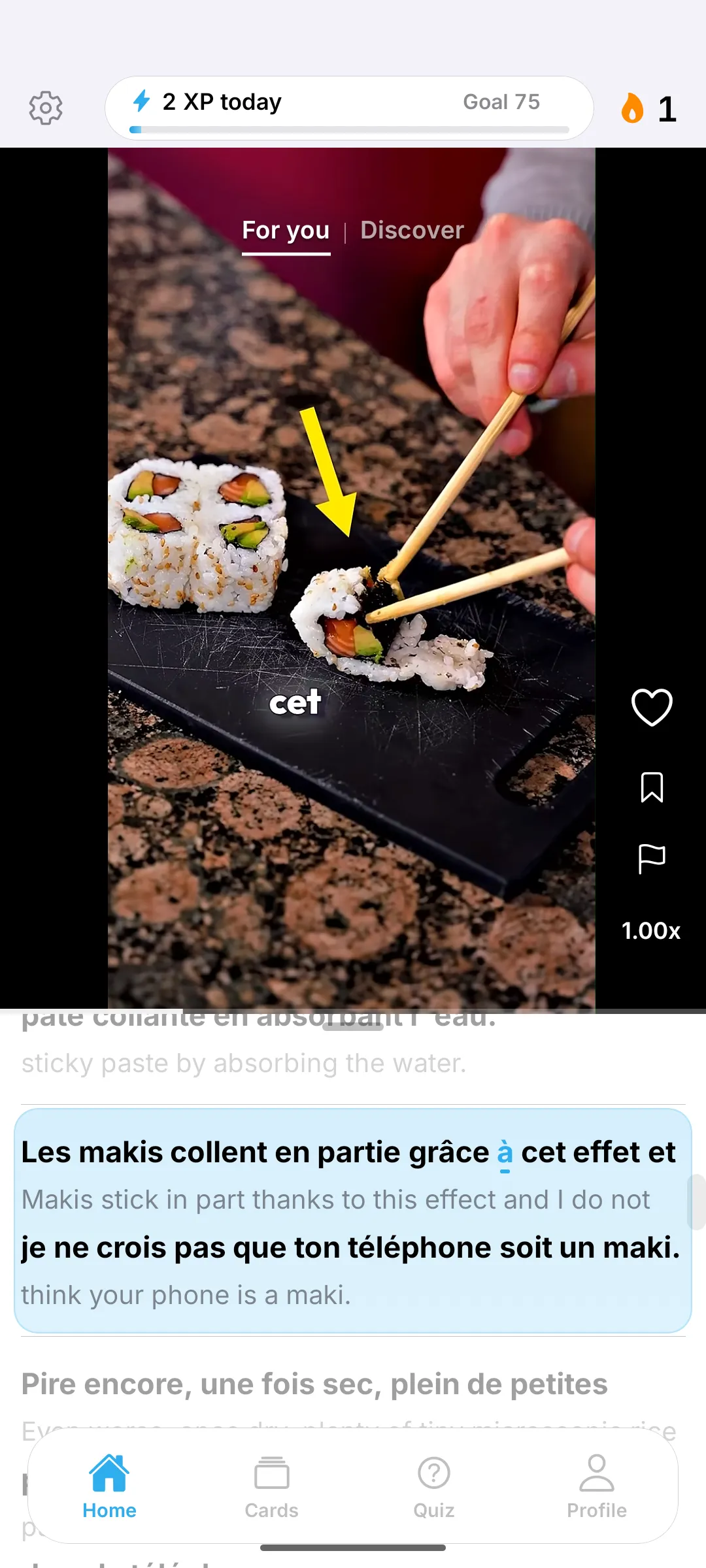
When a word stops you, an actuellement or a librairie, tap it, and a card opens with its translation, the kind of word it is and a note on what it is doing in that sentence (tap-to-translate). Swipe a line sideways for a breakdown of how it fits together. One tap saves it, and saved words come back as flashcards when you are about to forget them. The feed also follows your level, with slower-spoken videos for beginners and quicker ones for advanced learners, and you can turn the speech speed down in settings (videos at your level).
Bingua works without an account. It is a subscription app; see pricing.