Why is spoken German hard to follow if it isn’t fast?
Because German often holds back the word that tells you what is happening until the end of the sentence, and packs several ideas into single long words, so you have to keep a lot in your head before the meaning arrives.
Speed is not the problem it seems. Pellegrino, Coupé and Marsico (2011) compared adult speakers of seven languages reading comparable short texts at a normal pace. German averaged about 6.0 syllables per second and English about 6.2, and the difference between the two was not statistically significant. If German sounds fast to you, it is because the sentence is built in an order your English ear does not expect, not because there is more sound.
Why does the meaning come at the end of a German sentence?
Because German puts the verb, or part of it, last in many sentences. In most main clauses the conjugated verb sits in second place, but in a clause introduced by a subordinating conjunction such as weil, ob or nachdem, it moves to the end (Grimm Grammar). Ich bleibe zu Hause, weil ich morgen früh arbeiten muss leaves muss until the very last word.
Separable verbs do something similar even in main clauses. A verb like anrufen (to call) splits in two: the main part stays near the front and the prefix goes to the very end of the sentence (Grimm Grammar). In Ich rufe dich morgen nach der Arbeit an, you hear rufe early on, but an is what turns “shout” into “phone”, and it comes last.
For a listener this changes the job. In English you can usually start working out the meaning from the first few words. In German you often have to hold the whole sentence in mind and let the last word decide what it meant.
How do German compound words work?
German writes compounds as one word, however many parts they have. The official spelling rules say nouns combined with other nouns, adjectives, verb stems or particles are written together: Crashkurs, Hoheitsgebiet, Holzbearbeitung (Rat für deutsche Rechtschreibung, §37).
In writing, you can see the parts. In speech, a compound arrives as one long run of syllables, and the part that tells you what the thing actually is often comes last: Holzbearbeitung is Holz (wood) plus Bearbeitung (working). Learning to hear compounds means learning to split them as they go past, which is far easier when you can see the written word at the same time.
Du, ihr or Sie, and which “sie” is it?
Sie is the formal “you”, and du and ihr are the informal ones. Du is for one friend, a young person, a child or a pet, and ihr is the same for more than one person. Sie is what you use when meeting adults for the first time, and it is common even among long-term acquaintances and colleagues (Grimm Grammar).
The listening trap is that Sie (you, formal), sie (she) and sie (they) all sound exactly the same. The capital letter only exists on paper, so in speech you have to work out which one you heard from context and the verb ending: sie geht is “she goes”, while sie gehen or Sie gehen is “they go” or “you go”.
Which German will you hear: Germany, Austria or Switzerland?
All three use Standard German, but each has its own words, and Switzerland adds a second layer: everyday speech in dialect. The official spelling rules are agreed jointly by Germany, Austria, Switzerland and the other German-speaking regions, and they record national differences: in Switzerland and Liechtenstein, ss can always be written in place of ß, so Straße becomes Strasse (Rat für deutsche Rechtschreibung, §25).
Vocabulary differs too. Austrians call January Jänner, which Duden marks as Austrian and less often southern German (Jänner), and a Swiss speaker may call a mobile phone a Natel rather than a Handy (Handy).
Switzerland is the big one for listening. German-speaking Swiss always speak dialect with each other, while in Germany public life is almost entirely in Standard German (Radio SRF). So video of Swiss people talking to each other is likely to be in dialect, which is a different listening task from the Standard German you learn from books and courses.
Which German words look English but aren’t?
A handful of common ones, and because they look so familiar they are easy to misread without noticing. German and English share a lot of everyday vocabulary, which is a real head start, but these five, checked against Duden, mean something else:
- Gift means poison: a substance that harms or kills an organism once it gets in (Gift).
- Bekommen means to receive or get, as in Post bekommen (to get mail), not “become” (bekommen).
- Eventuell means possibly or under certain circumstances, not “eventually” (eventuell).
- Aktuell means current or topical, not “actual” (aktuell).
- Handy is a mobile phone. Duden traces it to the English adjective handy, but in German it is a noun (Handy).
Then there is gender. Every noun is masculine, feminine or neuter, marked by der, die or das, and there is no real logic to which is which, so each one is learned with its noun (Grimm Grammar). The upside for a listener is that the article you hear narrows down which noun is coming.
How should you practise German listening with native video?
Pick videos you can mostly follow, keep the German text on screen, and get used to holding a sentence open until its last word. These habits work with any video and any app:
- Start with Standard German. Speakers from Germany or Austria addressing a general audience are the place to begin. Leave Swiss friends chatting in dialect until later, as a separate challenge.
- Wait for the last word. When a clause starts with weil, dass or ob, expect the verb at the end, and don’t decide what a sentence means until you have heard the prefix of a separable verb.
- Read along to split compounds. Seeing Holzbearbeitung written while you hear it teaches you to find the seams in long words. Our page on dual-language subtitles covers the research on reading along.
- Turn the speed down for long sentences. Slower playback gives you time to hold the start of a sentence in mind until the end arrives. Our page on videos at your level explains how speech rate affects comprehension.
- Use the verb ending to sort out sie and Sie. -t or -en after sie is often the only clue to whether someone means “she”, “they” or “you”.
- Check false friends in the moment. If Gift or eventuell goes past, look it up rather than trusting the English look-alike. Our page on tap-to-translate covers why checking meanings as you go helps.
For the reasoning behind this approach, see our guide to comprehensible input: understanding a lot of real German is what builds the ear. If textbook German feels comfortable but native speakers still lose you, our guide to the intermediate plateau explains why that stage feels stuck.
Learning German one scroll, and one sentence, at a time
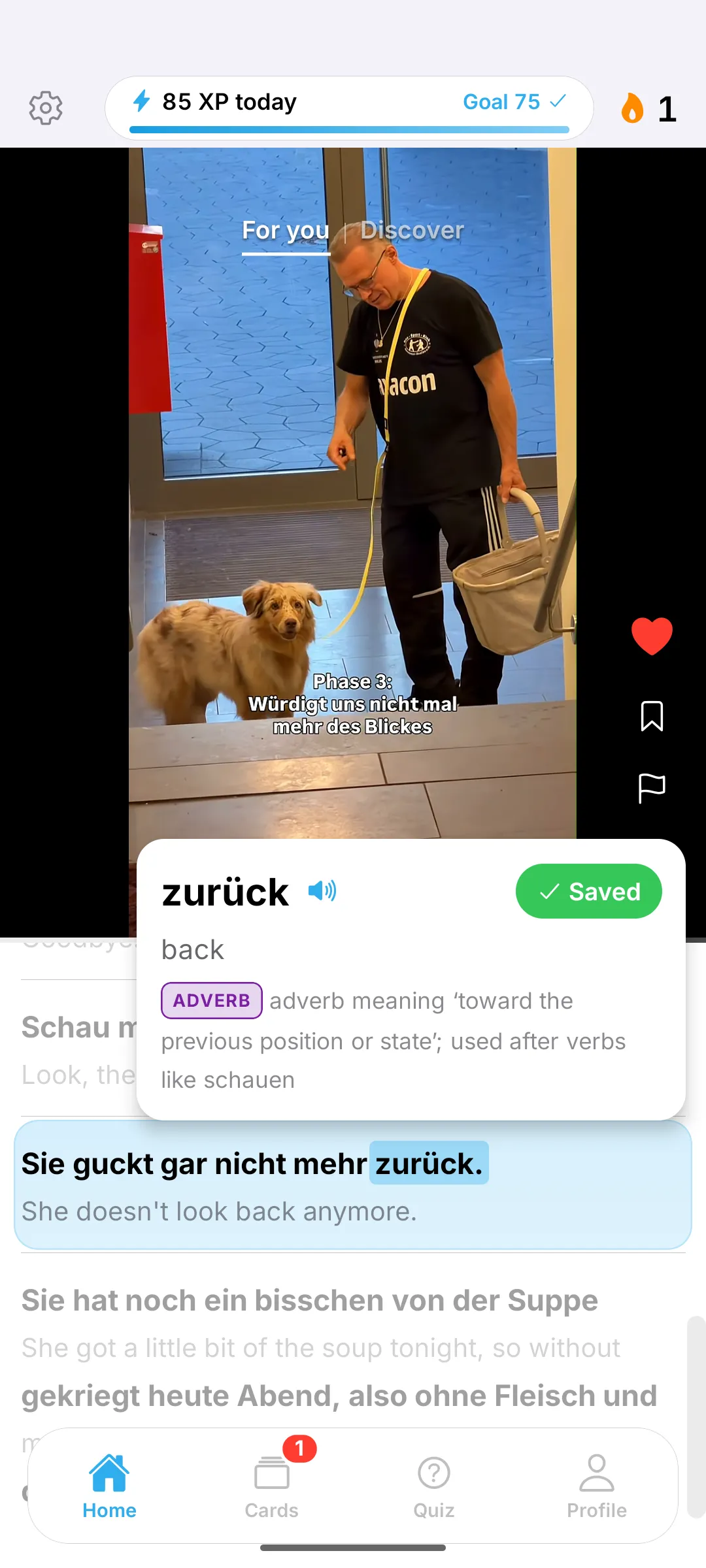
Bingua is an iPhone app for learning German from real videos made by native speakers, with dual-language transcripts you can tap for instant translations and flashcards built from the words you save.
Using it feels more like scrolling a feed than sitting a lesson, and that is what makes it easy to keep up. The videos are picked around the subjects you chose when you set up and matched to your level, and you scroll from one to the next for as long as you like. The grammar a course would drill turns up inside the videos instead, and you deal with it when it comes.
That is where the sentence breakdown earns its place. When a line ends in muss or an and you have lost the thread, swipe it sideways for a short breakdown of how the whole sentence fits together, the kind of thing a tutor would lean over and tell you (tap-to-translate). In a language that saves its verbs for the end, that can be the moment a sentence finally clicks.
Single words are one tap away: tap a Gift or an eventuell and a card shows its translation, the kind of word it is and a note on what it is doing in that sentence. The transcript scrolls in time with the speech, the German line above and the English beneath it, so a long compound is there in writing while you hear it (dual-language subtitles). Beginners get slower-spoken videos and advanced learners quicker ones, and the speech speed can be turned down in settings (videos at your level). Words and sentences you save come back as flashcards when you are about to forget them.
Bingua works without an account. It is a subscription app; see pricing.